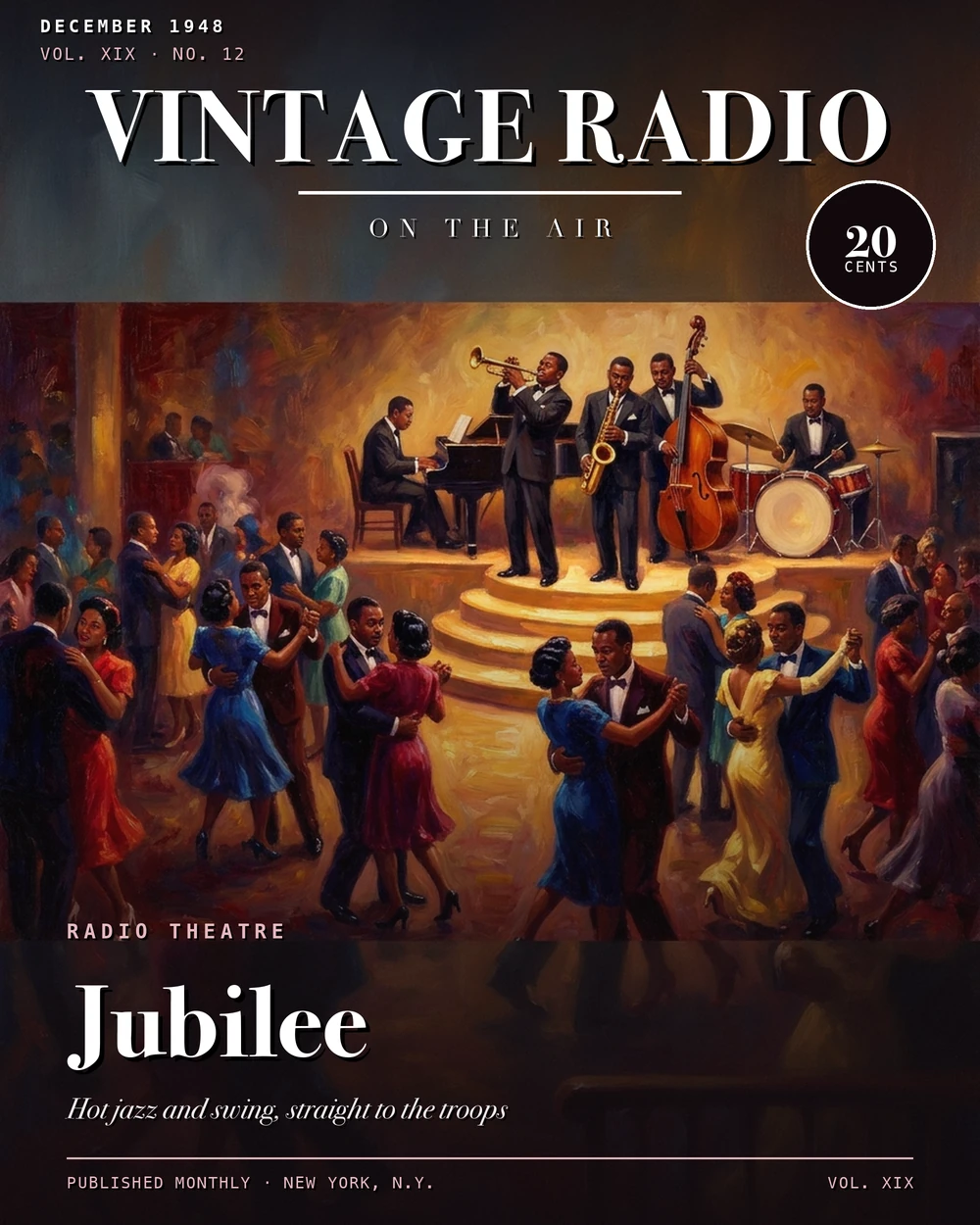
Jubilee
A Show That Wasn't Meant for Home Listeners
Jubilee never aired on your home radio. From October 9, 1942, through August 14, 1953, it existed exclusively for U.S. service personnel stationed overseas — first under the Special Services Division of the War Department, then under the Armed Forces Radio Service. That unusual distribution setup turned out to have an unexpected side effect: because the show carried War Department status, it was exempt from the musicians' union recording bans of 1942–43 and again 1947–48. That meant artists who couldn't cut commercial records during those periods walked into a studio and performed for Jubilee anyway. The result was a body of recordings capturing musicians at full strength during some of the most contested years in American recording history.
The show was conceived at least in part as a morale-building service for Black troops overseas. Wartime military policy meant that approximately fifteen percent of the U.S. military's African American personnel were largely restricted to non-combat, rear-echelon duties, and the resentment that produced was well-documented. Jubilee addressed that directly — and it did so by showcasing Black jazz and swing artists who had been consistently underserved by the commercial radio networks. The show's mission also fit inside a larger movement: the Double V campaign, Black Americans' wartime call for victory abroad against fascism and victory at home against racism. Within that frame, the show's platform for Black artists wasn't simply entertainment — it was understood as validating their contributions to the war effort and supporting the broader push for racial uplift at home. The program eventually reframed its own mission in its closing credit, stating it was produced for "the Fighting Men of the United Nations" — a reach beyond Black servicemen to Allied troops worldwide. But the musical identity of the show in its peak years was rooted squarely in the Black music that the networks had given short shrift.
The Performers
The roster from Jubilee's 1942–1945 run reads like a census of the most important names in Black jazz and swing. Duke Ellington, Count Basie, Fletcher Henderson, Cootie Williams, and the King Cole Trio supplied the instrumental firepower. Lena Horne, Ella Fitzgerald, Ethel Waters, the Ink Spots, Eddie "Rochester" Anderson, and trumpet-vocalist Valaida Snow filled out the variety. Louis Armstrong, Fats Waller, Art Tatum, Cab Calloway, Lionel Hampton, Jimmie Lunceford, Dinah Washington, Sister Rosetta Tharpe, Lucky Millinder, Erskine Hawkins, Teddy Wilson, Louis Jordan and His Tympany 5, the Delta Rhythm Boys, the Golden Gate Quartet, the International Sweethearts of Rhythm, the Mills Brothers, and Dorothy Donegan all appeared. So did Butterfly McQueen, who turned up repeatedly as a recurring comedic presence throughout 1943 and 1944.
In early 1944 the show began integrating white guests into its playbill. Johnny Mercer, Jack Benny, and Bob Crosby were among the first. A Valentine's Day 1944 broadcast put Cab Calloway and the Nat King Cole Trio on the same bill as George Burns and Gracie Allen. The March 6, 1944, broadcast stands out as one of the few surviving radio appearances by Andy Kirk's Twelve Clouds of Joy orchestra, paired with vocalist June Richmond. Episode 58, recorded December 27, 1943, brought together Louis Armstrong, Art Tatum, Fats Waller, the Mills Brothers, Thelma Middleton, and Barney Bigard in a single half-hour. Episode 85, from June 26, 1944, paired the Jimmie Lunceford Orchestra and the Nat King Cole Trio with Butterfly McQueen and Carmen Miranda on the same stage. These weren't promotional showcases — they were live recordings made for soldiers, with no commercial constraints shaping the lineup.
The People Behind It
The first few episodes of Jubilee were produced in New York by Captain Charles Vanda, a former CBS west coast programming director. An early collaborator during that New York period was Dore Schary, who later became production manager and then president of Metro-Goldwyn-Mayer. Production shifted to Los Angeles not long after launch, and from there Major Mann Holiner took over. In 1944 and 1945, Sergeant James "Jimmy" Lyons — a former San Francisco disc jockey — ran the show. When Jubilee was revived in 1952 for the Korean War period, Bill Scott stepped in as producer.
The emcee role shaped the show's personality on air. Early episodes were hosted by Dooley Wilson — the actor and singer who played Sam in the 1942 film Casablanca and performed "As Time Goes By." Wilson's warm, grounded presence set the tone. From 1943 to 1945, he was succeeded by Ernest "Bubbles" Whitman, born February 21, 1893, in Fort Smith, Arkansas. Whitman's background was genuinely unusual: educated at Tuskegee Institute and ordained as a minister in 1907, he had pivoted to entertainment through Black vaudeville, burlesque, and revues before arriving in film and radio. His first film was a 1934 Vitaphone short alongside Bill Robinson. By the time he was hosting Jubilee he had appeared in The Prisoner of Shark Island, The Green Pastures, Jesse James, Gone With the Wind, Cabin in the Sky, Stormy Weather, and The Lost Weekend — an unlikely résumé for a radio emcee, and one that gave him the standing to hold his own with any guest on the show. Whitman brought a jive-talking, high-energy style that kept the show moving. He later played Bill Jackson on the radio and television versions of The Beulah Show before his death on August 5, 1954. Announcers Verne Smith and Bob Moon also had roles in the show's run.
How It Was Made
Episodes were formatted as 30-minute programs released weekly. Most were recorded before live audiences in Los Angeles, primarily at NBC Radio City in Hollywood, with additional work done at C. P. MacGregor Studios and, from around 1945 onward, at Universal Recorders. The finished programs were pressed onto 16-inch vinylite discs running at 33⅓ rpm — the standard transcription format of the era — and shipped by priority air to military radio stations around the world.
The institutional lineage behind the show moved in three steps. Initial production and distribution ran through the Office of War Information; from there responsibility passed to the Special Services Radio Section; and finally, in November 1943, the War Department Special Services Division Radio Branch was formally reorganized as the Armed Forces Radio Service. The credit on the closing discs shifted in December 1943 to reflect that changeover, from "The Special Services Division of The War Department" to "The Armed Forces Radio Service." The show carried the catalog designation H-11 throughout. Music from Jubilee was also fed into other AFRS programs — the disc jockey shows "Downbeat" and "Sound Off" among them — and into the AFRS Basic Music Library, a collection designed by Major Meredith Willson to supply military radio stations with current recordings during the musicians' strike period.
The postwar version of the show looked different from the wartime one. After 1945 the playbill became more racially mixed, and music was provided by an AFRS orchestra led by Michael Perriere rather than by the rotating guest-band format of the early years. Jubilee ran continuously through approximately February 1950, then went dark. AFRS revived it in approximately September 1952 for the Korean War period, and it ran until around November 1953. A Christmas Day 1952 episode, numbered 380, featured Ray Anthony, Michel Perriere, Georgie Auld, and the Jud Conlon Rhythmaires — a snapshot of how much the show's texture had changed from the Ellington and Basie years.
What Survived and Why It Matters
Approximately 433 episodes of Jubilee survive, most of them in excellent audio condition — a consequence of the quality of the NBC Radio City Hollywood sessions and the relative care with which military transcription discs were manufactured and stored. Early pressings were handled by Columbia and RCA; Episode No. 1 carries the label notation "Mfg. by Columbia Record Corp." The institutional mechanisms that produced the show also helped preserve it: the AFRS Program Lists for 1942–1945 provide the primary documentary basis for chronologically dating releases.
The series is considered an important piece of Black heritage in musical radio history. Many of the performances captured on Jubilee discs exist nowhere else — recordings made during union ban periods that never reached commercial release, by artists who weren't otherwise getting substantial airtime on the major networks. The 1985 discography compiled by Rainer E. Lotz and Ulrich Neuert, published in Frankfurt by Norbert Ruecker with a foreword by Richard S. Sears, author of V-Discs: A History and Discography, remains the foundational public reference for the series. Carl A. Hällström and Bo F. Sherman later produced updated editions that extended and corrected the original research. Significant holdings of Jubilee transcriptions are preserved in the Glenn Miller Archive collections at the American Music Research Center, University of Colorado Boulder, which catalogs the series and keeps it in active circulation by making episodes available on the weekly Star-Spangled Radio Hour broadcast — a living public resource rather than a sealed scholarly vault. Dennis M. Spragg, senior consultant of the Glenn Miller Archives at Colorado Boulder, contributed additional detail about the AFRS context during preparation for his 2017 book Glenn Miller Declassified. One of the few early institutional treatments of the show's context appears in Theodore Stuart DeLay Jr.'s unpublished 1951 dissertation, "An Historical Study of the Armed Forces Radio Service to 1946," presented to the University of Southern California.
Jubilee wasn't designed to be a historical document. It was designed to give Black servicemen something to listen to, and to give Black musicians a platform the networks weren't providing. That it became both a significant artifact of wartime broadcasting and an irreplaceable archive of jazz and swing performance in the 1940s was a side effect of doing that job carefully, on good equipment, week after week, for a decade.